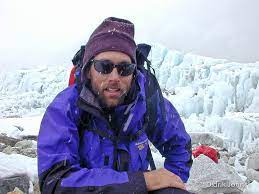

Imagine standing at the base of the world’s tallest mountain, driven by a burning desire to climb to its summit. Imagine again undertaking this great challenge as a blind individual, not willing to stop at anything. This is the remarkable story of Erik Weihenmayer, a man who defied all odds and conquered Mt. Everest on 25th May, 2001, through perseverance, proving to the world that blindness or physical disability does not define a person’s potential. This blog post will explore Weihenmayer’s incredible journey, focusing on his background and the challenges he faced along the way to achieve his dream of climbing Mt. Everest.
Background story
Erik Weihenmayer was born in 1968 in Boulder, Colorado, to a loving family that included his parents, Ed and Elsa, and his younger brother, Jeff. Erik was diagnosed with a rare eye disease called retinitis pigmentosa (retinoscheses) at a young age, around three years old. This condition causes progressive vision loss, eventually leading to blindness. At age 13, Weihenmayer’s life took a dramatic turn. He lost his eyesight completely due to the disease. Initially, it was very difficult to adjust to his current predicament; however, he managed to get along. In his own words, Erik shares, “When I was thirteen, I became blind from a rare disease, retinoscheses. There were a few months of frustration when I wasn’t really sure what I’d be able to do, but something interesting happened. I didn’t really want to accept blindness and accept myself as a blind person. I didn’t want to be identified as a blind person, but I found something interesting: when I actually accepted blindness–I didn’t try to transcend it or go beyond it or beat it but just accepted it–that was the greatest thing I could ever have done. I went off to a rehabilitation center where I learned how to use computers, a center like the Colorado Center, the Minnesota center, or the Louisiana Center, and learned how to use a cane and learned Braille. I found that, when I was able to read a poem in Braille in front of my class or was able to walk down a hallway with a cane with my buddies, those things that I thought would separate me actually connected me back to the world.” [1]
What next?
After Erik overcame the difficulty of living with blindness, he thought of what else he could learn to overcome and get to the top. His father suggested rock climbing. He enrolled in a program that teaches blind kids going rock climbing. In the program, he learnt to climb using the sense of touch by feeling rock surfaces with his hands and feet and that led to all sorts of climbs. Over the years, he climbed rocks, ice and mountains all around some of which many, including experts earlier, said he couldn’t. Erik, through faith, a positive attitude towards life, and determination, learnt to live a life of no limits.
It’s worthy of note that for six years before his adventure and speaking career took off, he taught English and math as a 5th grade school teacher. At some point in time, to help his students live what he calls the “No Barriers Life”, he and his team developed two educational programs:
- Touch the Top Curriculum Program, which uses his first memoir as a multi-discipline and delves into the experiences that formulated his mindset and life’s vision.
- No Barriers Climb Program, an activity-based curriculum to teach the No Barriers Life in a lively and engaging way
Participants in these programs included youths of all abilities and backgrounds, those with physical disabilities, as well as those with invisible barriers: first-generation Americans, teens in the foster-care system, young people who have faced physical or emotional trauma, and kids in the suburbs who simply crave purpose and direction. These programs are for anyone who yearns to thrive in the face of Everest-size challenges and tap into our No Barriers belief, “WHAT’S WITHIN YOU IS STRONGER THAN WHAT’S IN YOUR WAY.”
The Mt. Everest Expedition:
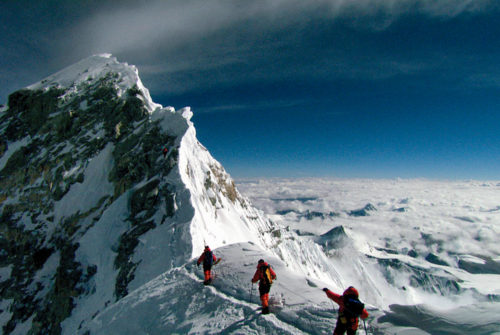
Erik Weihenmayer’s ambitious goal of climbing Mt. Everest was not without immense obstacles due to his blindness. The sheer scale and complexity of the mountain presented unique challenges for Weihenmayer, who had to rely on his other senses and the guidance of his climbing partners to navigate the treacherous terrain.
One of the most significant challenges Weihenmayer faced was the lack of visual cues that most climbers rely on to navigate the mountain. He had to rely on his sense of touch to feel his way up the mountain, using his hands and feet to scan rock formations and find holds. This required immense skill, adaptability, and courage, as he had to learn to trust his instincts and the guidance of his team.
Harsh weather conditions added to the challenges Weihenmayer faced on Mt. Everest. Blinding snowstorms, sub-zero temperatures, and high winds made it difficult for Weihenmayer to maintain his balance and navigate the mountain. He had to rely on his other senses, particularly his hearing, to stay oriented and avoid falling into crevasses or off cliffs.
Treacherous terrain also presented unique challenges for Weihenmayer. The icy slopes, steep inclines, and narrow ridges required immense strength, balance, and agility, all of which were more difficult for Weihenmayer to master without the benefit of sight. He had to rely on his climbing partners to guide him through the most challenging sections of the mountain, using verbal cues and a system of tethers to navigate the terrain.
Doubts from others also presented a challenge for Weihenmayer. Some questioned whether a blind person could safely and successfully climb Mt. Everest, citing the risks and challenges involved. However, Weihenmayer refused to let these doubts deter him, focusing instead on his own abilities and the support of his team.
The Power of Perseverance:
Erik Weihenmayer’s unwavering determination and perseverance in the face of adversity are a testament to his resilience and refusal to give up. Despite the immense challenges he faced on Mt. Everest, Weihenmayer refused to let his blindness define him or limit his potential.
One specific anecdote that demonstrates Weihenmayer’s perseverance is the story of the “death zone,” the final section of the mountain above 26,000 feet, where the air is thin, and the risks of altitude sickness, frostbite, and other hazards are high. Weihenmayer’s climbing partner, Jeff Evans, recalls how Weihenmayer pushed through the pain and exhaustion, refusing to give up even when the odds seemed insurmountable.
Another moment of perseverance came when Weihenmayer became trapped in a blizzard, unable to see or hear his teammates. Instead of giving up, Weihenmayer dug deep and found the strength to keep going, eventually reconnecting with his team and continuing his ascent.
Weihenmayer’s perseverance enabled him to push through obstacles, adapt to setbacks, and stay focused on his goal despite the odds. His unwavering determination and refusal to give up are a powerful reminder of the human spirit’s resilience and the power of perseverance in the face of adversity.
Lessons Learned:
Erik Weihenmayer’s remarkable journey offers valuable lessons for anyone facing challenges in their lives. Here are some key takeaways:
a. Don’t relegate yourself to the background
Weihenmayer’s story is a powerful reminder that physical disabilities do not define a person’s worth or potential. Instead of relegating himself to the background, Weihenmayer pursued his dreams with determination and courage, proving that anyone can achieve great things with the right mindset.
b. Never Pity yourself
Weihenmayer’s refusal to pity himself is a testament to his resilience and determination. Instead of focusing on his limitations, like most blind people I know do, he focused on his strengths and believed in his ability to achieve his dreams. This mindset is crucial for anyone facing challenges, as it enables them to overcome obstacles and pursue their goals with confidence.
c. Help yourself and others
Weihenmayer’s commitment to helping others is a powerful reminder that we are all interconnected and that we can achieve more together than we can alone. By creating programs to help young people achieve their dreams, Weihenmayer demonstrated the importance of giving back and using our strengths to help others.
d. Perseverance is key
Weihenmayer’s unwavering determination and perseverance in the face of adversity are a powerful reminder of the importance of perseverance in achieving our goals. Whether it’s overcoming a physical disability, pursuing a dream, or facing a challenge, perseverance is key to success.
Reflect on your own fears and obstacles and find inspiration in Weihenmayer’s example to pursue your dreams with courage and determination. Whether it’s starting a new business, pursuing a passion, or overcoming a personal challenge, perseverance is key to success.
Erik Weihenmayer’s remarkable journey to the top of Mt. Everest is a testament to the power of perseverance and the human spirit. His story offers valuable lessons for anyone facing challenges in their lives, reminding us that physical disabilities do not define a person’s worth or potential. By focusing on his strengths, believing in himself, and persevering in the face of adversity, Weihenmayer achieved his dreams and inspired others to do the same.
Share your story of perseverance and determination and encourage someone.
REFERENCES:
https://nfb.org/sites/default/files/images/nfb/publications/bm/bm02/bm0205/bm020504.htm
https://www.britannica.com/biography/Erik-Weihenmayer
IMAGE SOURCES:
- https://images.app.goo.gl/th9awC8ymLYKEsAF7
- https://erikweihenmayer.com/wp-content/uploads/2018/05/everest-home-page-feature-box-500×335.jpg